

Research and development work on the analysis and design of the database structure for “Settlement accounts”, for AeroMar (Miracle)
Read more ↗Projects
Business applications · financial processes
From a delivered service to a settled invoice.
I.V.A. developed IMS for AeroMar, an invoicing and settlements system built on Miracle16. It connected service records, invoices, bank documents and payments, accounting for currencies and individual customer terms.
From the company archive
documentscalculation rulesshared data

01
Challenge
Delivering a service, issuing an invoice and receiving payment are distinct events. A payment could arrive in advance, settle part of a debt or require currency conversion. Each amount needed to remain connected to its customer, service and document, allowing subsequent operations to use information already entered.
02
Our contribution
I.V.A. designed and implemented the application on its own Miracle16 platform. The work covered data structures, interaction between applications, calculation rules, input forms and user documentation. In 1999, AeroMar received a non-exclusive licence for Miracle.
03
Solution
IMS — Invoice-Mutual Settlement — combined reference applications, document processing and analytical applications. Reference records defined customers, bank details, currencies, operations and settlement terms. Operational applications created source documents, invoices, payments, tax invoices and the sales ledger. The design provided for preparing data for SunSystems through an export journal and an external file. The system connected two flows: records of goods and services supplied and incoming payments recorded in bank documents.
05
Document processing controls
Controls also governed the sequence of document processing. Source amounts were included in an invoice with protection against billing them again in another invoice. Final printing locked the invoice against changes; a preview print without registration left it editable. Payment tracking distinguished unpaid, partially paid and fully paid invoices. These application rules defined a document’s lifecycle: when an operation was permitted and how its result would be used next.
06
Configurable calculations
Calculation settings operated at several levels. Customers and their subtypes could have their own currencies, periods and markups. Algorithms calculated additional amounts, and the user guide allowed enterprise specialists to modify them. Accounting policies had effective dates, linking the selection of a tax-invoice rule to the document date. IMS retained both amounts and the conditions under which they were processed.
07
Outcome
IMS applications and detailed operating instructions were developed for recording services, issuing invoices, allocating payments and handling advances. Surviving screens show the system’s interface and its connection to Miracle. Separate proposals addressed further development of the financial manager; they are not included here as confirmed capabilities.
08
Historical assessment
The project’s significance in the late 1990s lies in applying a proprietary component platform to a specific financial workflow. Its notable features include coordinated applications, notifications of shared-data changes and controlled transitions between document states. Databases of that period already supported concurrent access; the engineering task in IMS was to express the enterprise’s rules and make them understandable to users.
System interface
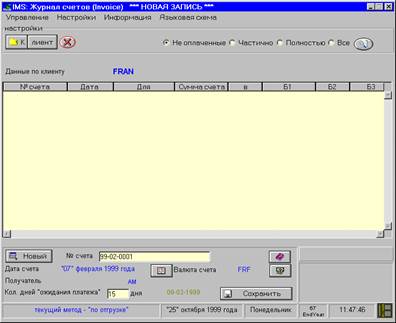
From company records
Materials
Project in the timeline
Sale of a non-exclusive licence to use the computer program (Miracle — ЗАО АэроМар)
Read more ↗Start with your challenge