

TIGR — Telegram Integrated Git Runner: an internal work management system in ongoing use, integrating GitHub and Telegram, version 4.4.5. Customer requests are kept separate from product code. Developers work in product repositories and use TIGR to read tasks and discussions and write replies without direct access to the customer issue repository. Reports give the team lead and the assignee a shared factual basis for reviewing work delivery.
Projects
An internal work management system
TIGR
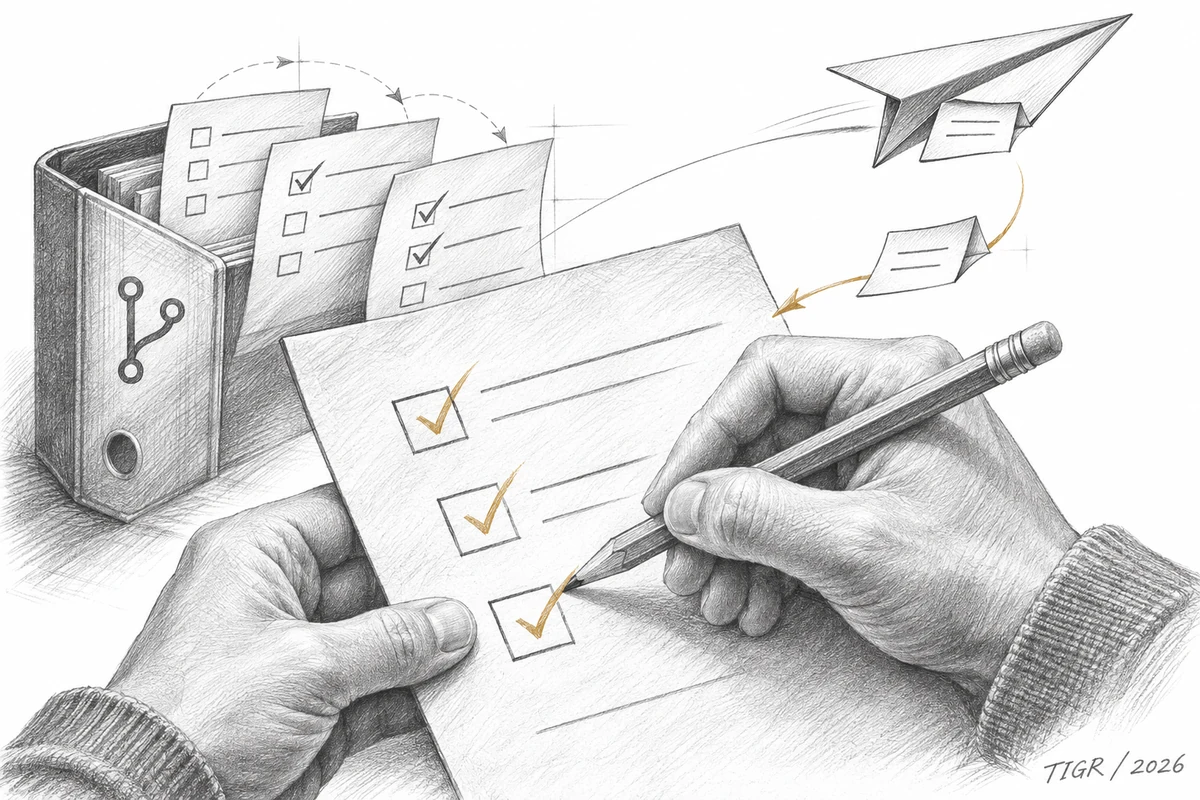
TIGR — Telegram Integrated Git Runner — is a task management system integrating GitHub and Telegram, used by the team on an ongoing basis. It connects customer requests with execution: synchronising Issues, tracking statuses, sending notifications through a Telegram bot and enabling task work directly in the messenger.
Customer requests and product code are kept separate. Customers submit tasks and report bugs in a dedicated repository without access to the code. Developers work in product repositories and use TIGR to read tasks and replies and write their own replies without direct access to the customer issue repository.
Internal use · version 4.4.5
tasksdiscussionstatuses
01
Why TIGR was created
Custom software development needs to connect customer requests with the team’s work while keeping access to issue discussions separate from access to product source code. Receiving a task, clarifying requirements, changing its status and preparing a report should not become a separate administrative job.
TIGR helps organise this process: the assignee receives a task, accepts it, carries out the work and closes the task. The system connects requests, work items, statuses and notifications, reducing manual coordination.
02
Customer requests separate from product code
A dedicated GitHub repository is used for communication with the customer: it records tasks, requests and bug reports. It is a channel for issues and discussion; product source code is stored in separate repositories to which the customer is not granted access.
Developers work on code in the product repositories. They do not need direct access to the customer issue repository to read its requests: TIGR displays the full description of an available task, shows participants’ replies and lets them write a reply of their own.
Customer discussions and development remain connected, while access follows each participant’s role: customers work with requests, and developers with code and their assigned tasks.
03
From assignment to completion
Assignment → receipt and acceptance → execution → closure.
TIGR synchronises Issues from GitHub repositories and tracks work status. Participants read task descriptions, follow discussions and leave replies within their granted access. Notifications help the relevant people learn about changes, while current statuses show how work is progressing.
04
Two access areas, one system
In the local area, the team lead plans work, monitors deadlines and workload, and reviews reports for the team and individual assignees. Plans can be compared with the recorded course of execution, with access to the details of each work item.
A separate remote access area exposes the tasks, discussions and actions needed by managers and assignees. The team lead can also remotely view work and connection monitoring within the permissions granted.
These are two access areas of one system. Remote access does not require exposing the full administrative interface.
05
Telegram in everyday work
Managers receive notifications through a Telegram bot, while programmers can handle everyday task work directly in the messenger: receiving and accepting tasks, replying and changing their status.
The web interface and Telegram complement each other. A simple action, such as replying to a task or changing its status, should not require learning a complex system.
06
A shared factual basis for reviewing work
The team lead can see more than a task’s current status. Reports show planned and actual dates, recorded time, workload distribution and the course of execution. A report can be used to open a work item and examine its history, including starts, pauses, resumptions and completion. Reports can be exported to PDF.
Each developer can obtain a report on their own work. The team lead and the assignee use shared recorded data to see what has been completed, deviations from the plan and circumstances that need discussion.
This transparency provides a factual basis for assessing the quality of work delivery and the accuracy of planning. Schedules and effort are considered alongside task complexity and the result achieved.
07
Current use
The team uses TIGR on an ongoing basis to organise its work; the current version is 4.4.5. The system brings together customer requests, assignee tasks, discussions, notifications and reporting.
TIGR is used as an internal system. Public registration for external users is not provided; participants receive access according to their responsibilities and permissions.
Project in the timeline
TIGR — development begins on an internal work management tool. In December 2025, the basic core for connecting GitHub repositories takes shape, with team tasks forming the basis of a shared workflow.
Start with your challenge